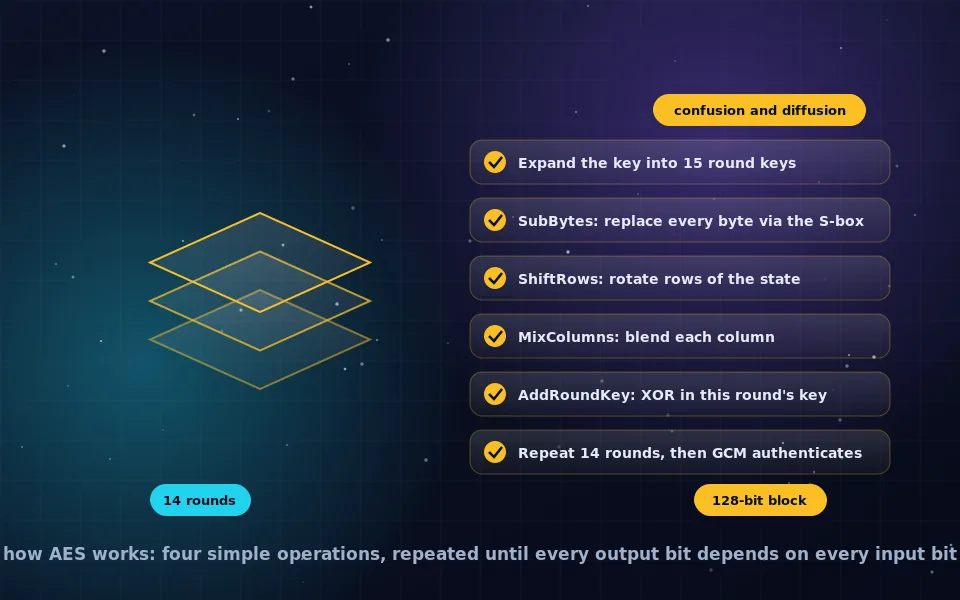
AES-256 encryption is the Advanced Encryption Standard used with a 256-bit key: a symmetric block cipher that encrypts data in 128-bit blocks through fourteen rounds of key-controlled substitution and mixing. Against brute force it is effectively unbreakable, since the number of possible keys is around 1.2 times 10 to the power 77, and no practical attack on the cipher itself is known. In practice, systems using AES-256 fail through weak passwords, poor key handling or compromised devices, never through the cipher.
AES-256 appears on almost every security product's feature list, and the phrase is repeated so often that it has become a marketing word rather than a description. This guide explains what AES is, what the 256 means, how AES-128 and AES-256 compare, how secure AES-256 actually is against real and theoretical attacks, and why the key size is almost never the part of a system worth worrying about.
What AES is
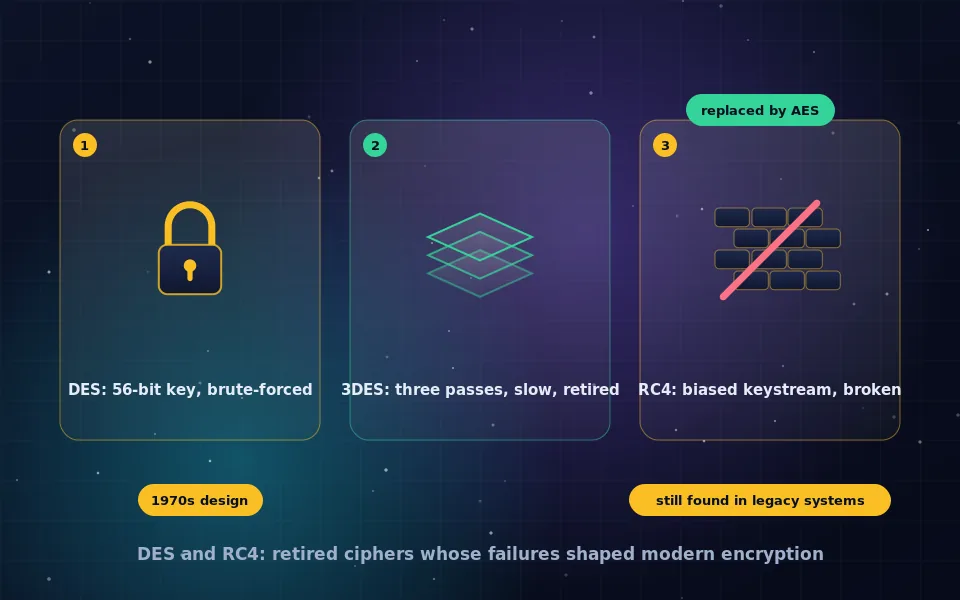
AES is a symmetric cipher, meaning the same key encrypts and decrypts, as the symmetric versus asymmetric guide on this site explains. It was selected through an open international competition and standardised at the start of the century as the replacement for DES, whose 56-bit key had become breakable. The algorithm chosen, originally called Rijndael, was designed to be secure, fast in both software and hardware, and simple enough to analyse.
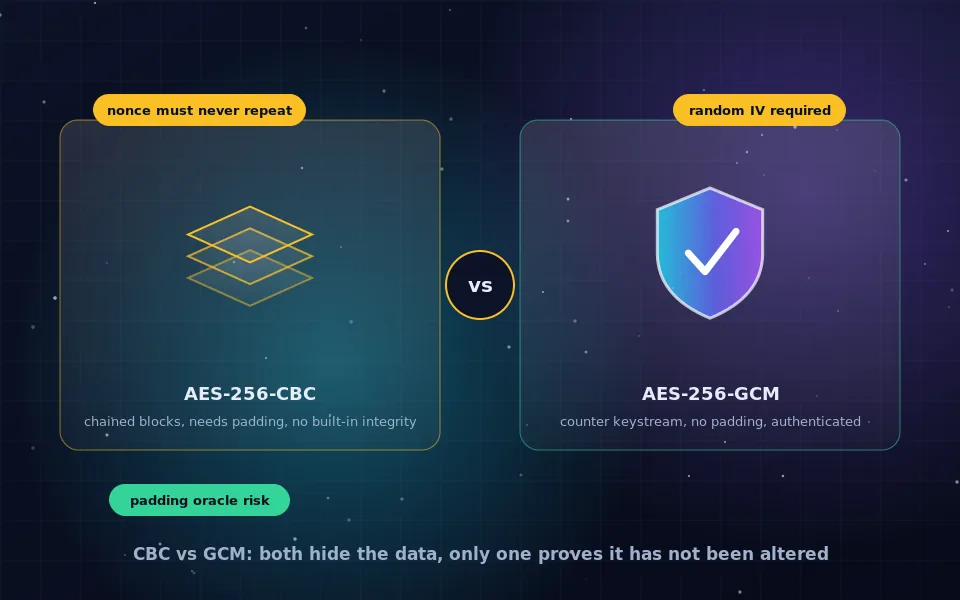
AES is a block cipher: it transforms fixed 128-bit blocks of plaintext into 128-bit blocks of ciphertext. Encrypting anything longer than 16 bytes requires a mode of operation that chains blocks together, and the choice of mode matters as much as the key size; the AES modes guide on this site covers CBC and GCM.
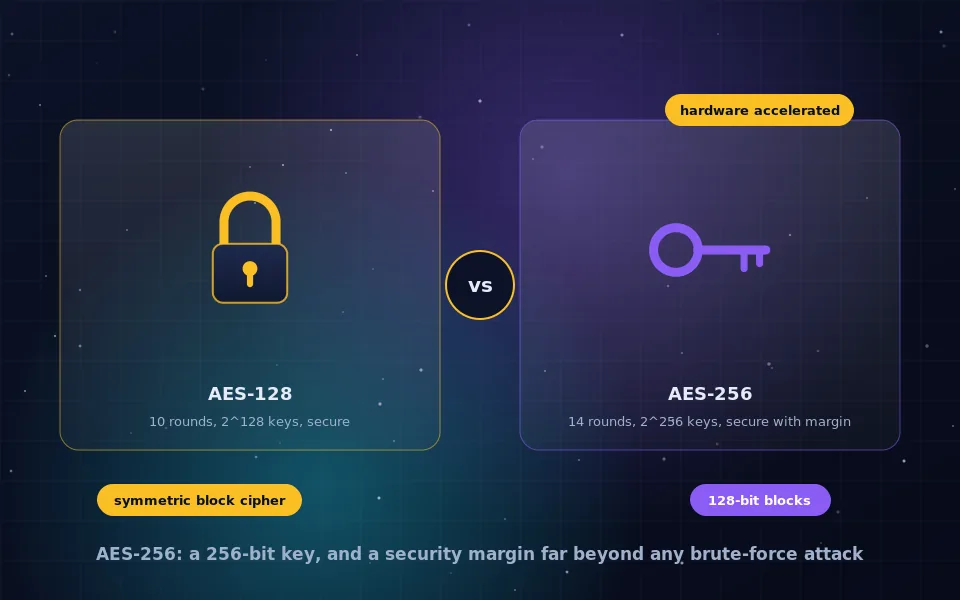
AES is used with three key sizes: 128, 192 and 256 bits. All three use the same structure with more rounds for longer keys: 10, 12 and 14 respectively.
What the 256 means
The 256 is the length of the key in bits. Every additional bit doubles the number of possible keys, so a 256-bit key has 2 to the power 256 possibilities. Written out, that is about 115 quattuorvigintillion, or 1.2 times 10 to the power 77, a number comparable to estimates of the number of atoms in the observable universe.
A brute-force attack tries keys until one works. If every computer on Earth tried keys at the fastest conceivable rate for the entire age of the universe, the fraction of the 256-bit keyspace covered would round to zero. AES-128 is also far beyond brute force at 3.4 times 10 to the power 38 keys. The extra 128 bits in AES-256 are a margin, not a necessity against brute force, and they matter for two other reasons described below.
AES-128 versus AES-256
Both are considered secure against all known attacks. The differences are practical.
- Speed. AES-256 runs 14 rounds instead of 10, so it is roughly 40 percent slower in software. With hardware acceleration, present in nearly all modern processors, both are fast enough that the difference rarely matters.
- Margin against cryptanalysis. Academic attacks on reduced-round versions of AES exist for both key sizes and none threaten the full cipher. AES-256's extra rounds and key length give more room if future analysis improves.
- Quantum resistance. Grover's algorithm on a large quantum computer would halve the effective key length. AES-128 would fall to 64 bits of quantum security, which is uncomfortable; AES-256 would fall to 128, which remains ample. This is the main reason AES-256 is recommended for data that must stay secret for decades.
- Regulatory alignment. Governments specify AES-256 for their highest classification levels, which pushes vendors to offer it by default.
For most purposes AES-128 is entirely adequate; AES-256 is the conservative choice and costs little.
How secure AES-256 really is
The honest answer has two parts.
Against attacks on the cipher: AES-256 has been studied publicly for over two decades by the world's cryptographers, and the best known attacks on the full cipher are only marginally better than brute force and entirely impractical. There are related-key attacks that apply in contrived scenarios where an attacker can manipulate the key, which do not apply to normal use. No one has decrypted AES-256 ciphertext without the key.
Against attacks on everything around the cipher: this is where AES-256 systems actually fail, and the failures are common.
- Weak passwords. When the 256-bit key is derived from a password, the attacker guesses passwords, not keys. An eight-character password gives far less than 256 bits of security regardless of the cipher.
- Key storage. A key saved in a file next to the data, hard-coded in software, or held by a service provider is available to whoever gets the file, the software or a court order.
- Mode and implementation errors. Using an inappropriate mode, reusing nonces in GCM, or implementing AES with timing leaks has broken real products that correctly used AES-256 as their cipher.
- Endpoint compromise. Malware on a device reads data after it is decrypted. AES protects data at rest and in transit, not data in use on a compromised machine.
- Side channels. Measuring power, timing or cache behaviour has recovered AES keys from poorly protected implementations, which is why hardware acceleration and constant-time libraries matter.
A product advertising AES-256 tells you the cipher is fine. It tells you nothing about the five items above, which are the ones that determine whether your data is safe.
Where AES-256 is used
Full-disk encryption on Windows, macOS, Linux, Android and iOS uses AES, mostly with 256-bit keys. VPN protocols offer AES-256-GCM, as the VPN guides on this site explain. HTTPS connections commonly negotiate AES-128-GCM or AES-256-GCM. Encrypted messengers, password managers, encrypted cloud storage, VeraCrypt volumes, 7-Zip archives and encrypted USB drives use AES-256. Wi-Fi WPA2 and WPA3 use AES. It is the closest thing to a universal cipher, alongside ChaCha20 where hardware acceleration is absent.
A five-question checklist for judging an AES-256 claim
- Which mode is used, and is it an authenticated mode such as GCM?
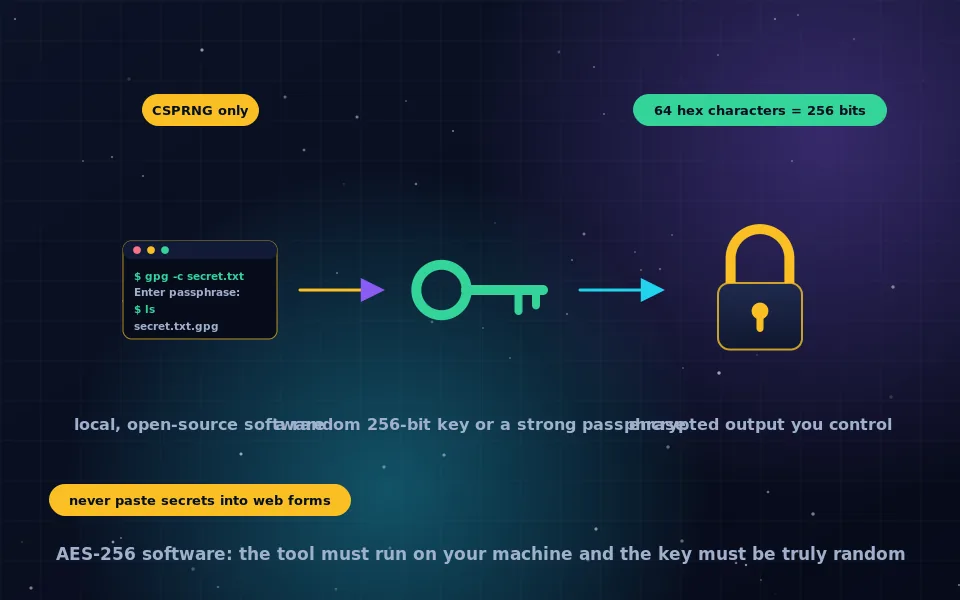
- Where does the key come from: a strong random source, or a password, and if a password, which derivation function and how many iterations?
- Who can access the key: only you, or the vendor as well?
- Is the implementation a well-reviewed library with hardware acceleration and constant-time operations?
- What protects the data once it is decrypted for use?
Good answers to those five make AES-256 mean something. Without them, it is a label.
What cryptographers and standards bodies say
The assessment above reflects the published consensus.
Standards bodies approve AES at all three key sizes for protecting sensitive information, specify AES-256 for the highest protection levels, and publish guidance on approved modes and key derivation because those are where implementations go wrong.
Academic cryptographers describe AES as one of the most thoroughly analysed ciphers in history, note that known attacks reduce its security only negligibly, and have documented that practical breaks of AES-based systems have targeted implementation, key management and side channels rather than the cipher.
Post-quantum guidance treats AES-256 as adequate against quantum attacks under Grover's algorithm and recommends it over AES-128 for long-term confidentiality.
Use the label correctly
AES-256 is a genuine assurance that the cipher will not be the weak point. Use products that offer it, then spend your attention on the things that actually break: choose a long passphrase, keep keys where only you can reach them, prefer authenticated modes, and protect the device. That is how AES-256 becomes real security rather than a phrase on a box.
Frequently asked questions
What is 256-bit AES encryption?
AES-256 is the Advanced Encryption Standard, a symmetric block cipher, used with a 256-bit key. It encrypts data in 128-bit blocks through 14 rounds of substitution and permutation controlled by the key. It is the strongest of the three AES key sizes and a global standard for protecting sensitive data.
How secure is AES-256 encryption?
Against brute force, effectively unbreakable: there are about 1.2 times 10 to the power 77 possible keys, and trying them all is beyond any conceivable computing resource. No practical attack on the cipher itself is known. Real systems fail through weak passwords, poor key management, bad implementation or malware on the device, not through AES-256 being broken.
What is the difference between AES 128 and 256?
The key length and number of rounds: 128-bit keys with 10 rounds versus 256-bit keys with 14 rounds. Both are considered secure against all known attacks. AES-256 offers a larger safety margin, including against future quantum computers, at a modest speed cost. AES-128 is somewhat faster and remains widely used.
Is 256-bit encryption the same as AES-256?
Usually. When a product says 256-bit encryption it almost always means AES with a 256-bit key. Occasionally the phrase refers to another cipher with a 256-bit key, such as ChaCha20. Look for the cipher name; the bit count alone does not identify the algorithm.
Can a quantum computer break AES-256?
Not practically. Grover's algorithm would reduce the effective strength of AES-256 to about 128 bits, which remains far beyond brute force. AES-256 is considered quantum-resistant, unlike RSA and elliptic-curve cryptography, which is one reason it is recommended for long-term protection.
Last reviewed and updated on . Plain text version: /encryption/aes-256-encryption.txt.